
First Time Home Buyer Ontario – Plan Your Move
The first offer you write is not the moment to find out that your down payment, closing costs, or preferred neighborhood do not line up. For a first time home buyer Ontario, the most valuable advantage is a clear plan before the search becomes emotional. In the GTA, where prices, property types, and competition can vary sharply from one community to the next, preparation creates room to make a confident decision rather than a rushed one.
Buying your first home is personal, but the process is practical. You need to understand what you can spend, what kind of property fits your life, and what conditions make sense for the specific home you are considering. The goal is not simply to get a set of keys. It is to buy a home you can enjoy and carry comfortably.
Start With Your Real Buying Budget
A purchase price is only one number in the decision. Before looking at listings, speak with a lender or mortgage professional about a mortgage pre-approval. A pre-approval can clarify your likely borrowing range, outline an interest rate hold where available, and show sellers that you are prepared when it is time to make an offer.
Still, a pre-approval should be treated as a starting point, not permission to spend to the absolute limit. Your comfortable monthly housing cost may be lower than the maximum a lender approves. Consider your regular expenses, future family plans, commuting needs, and the savings you want to retain after closing. A townhouse with manageable payments may offer more freedom than a larger home that leaves no margin for changes in rates or day-to-day life.
Your cash requirement also extends beyond the down payment. Ontario buyers should plan for legal fees, title insurance, a home inspection when appropriate, moving expenses, insurance, utility setup, and adjustments such as prepaid property taxes or condominium fees. Land transfer tax is another major closing cost. Eligible first-time buyers may qualify for a provincial land transfer tax rebate, and buyers purchasing in Toronto may also be subject to the city’s municipal land transfer tax, with a separate first-time buyer rebate potentially available.
Programs and eligibility rules can change, so confirm current details with the professionals supporting your purchase. If you are building your down payment, ask about options such as the First Home Savings Account and the Home Buyers’ Plan. The right choice depends on your income, savings timeline, and tax situation.
Choose a Home Type Before You Choose a Listing
The GTA offers very different first-home paths. A condo may place you closer to transit, work, and amenities, while a freehold townhome may provide more space and fewer shared-building obligations. A semi-detached or detached home can offer a larger footprint, but often comes with a higher purchase price and greater maintenance responsibility.
There is no universally best first property. The right answer depends on what you value most in the next five to seven years. If a shorter commute matters, a condo in Mississauga or Toronto may make sense. If more interior space, parking, or access to family is the priority, communities in Brampton, Caledon, Milton, Vaughan, or other parts of Peel, Halton, and York Region may deserve a closer look.
For condominium purchases, review the monthly condo fee and what it covers. A lower fee is not automatically better if a building has upcoming repairs or limited reserve funds. Status certificate review can reveal important information about the corporation’s finances, rules, insurance, and any known special assessments. For freehold properties, think beyond the layout. Ask about the age and condition of major systems, drainage, parking, property boundaries, and the costs you will assume as an owner.
First Time Home Buyer Ontario: Understand the Offer Process
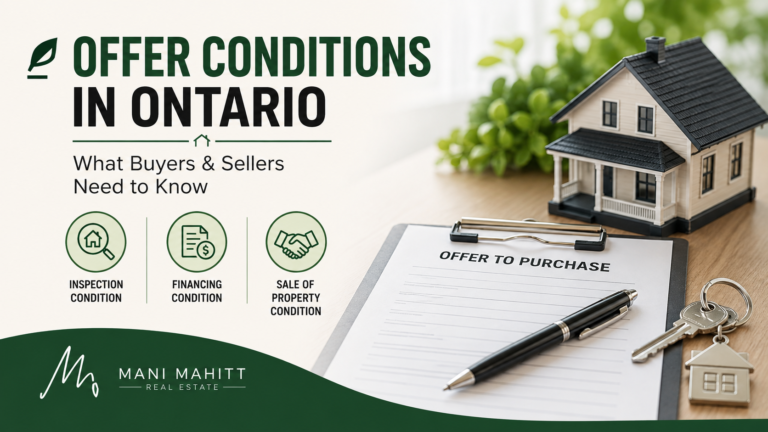
An offer is more than a price. It is a legal agreement with terms that can protect you, strengthen your position, or create unnecessary risk if they are not considered carefully.
Your offer may include a deposit, a closing date, inclusions such as appliances or window coverings, and conditions. Common conditions can include financing, home inspection, and, for a condo, review of the status certificate. In a highly competitive situation, some buyers feel pressure to remove conditions. That can make an offer more attractive, but it also increases your exposure if financing does not come together or the property has an issue you did not identify.
The best approach depends on the property, the seller’s expectations, market activity, and your level of certainty. A well-prepared buyer may be able to complete some due diligence before offering. In other cases, conditions remain the sensible choice. This is where responsive representation matters: you want clear advice on the trade-offs, not pressure to take a risk simply to compete.
Your deposit is usually due shortly after an accepted offer and is held in trust. It becomes part of your down payment on closing, but it also signals that you intend to complete the purchase. Have those funds accessible before you start making offers.
Read the Neighborhood, Not Just the Photos
A home can look excellent online and still be a poor fit once you understand its surroundings. Visit at different times if possible. A quiet weekday afternoon may not show traffic patterns, school pickup congestion, train noise, or weekend activity.
For buyers in the GTA, neighborhood value is often tied to the details of everyday life: transit access, road connections, school options, parks, shopping, future development, and the character of nearby housing. A property near a major route may be convenient for commuting but less appealing if outdoor quiet is a priority. A newer neighborhood may offer modern homes and growing amenities, while an established area may offer mature streetscapes and different renovation expectations.
Local market knowledge helps put those details in context. Two similar homes a few kilometers apart can attract different buyer demand because of school boundaries, lot size, transit access, or the reputation of a particular pocket. Looking at recent comparable sales is more useful than relying on a broad average for an entire city.
Avoid the First-Buyer Mistakes That Create Stress
The most common mistake is shopping before defining a realistic budget. The second is falling in love with a home before understanding the full cost of owning it. Neither is a failure of judgment. Buying is emotional, and listings are designed to make an impression. A process that keeps you grounded is the solution.
Give yourself room to compare homes against a written set of priorities. Separate non-negotiables, such as an accessible bedroom or commute limit, from preferences such as a finished basement or a particular kitchen style. That distinction becomes useful when a strong listing appears and decisions move quickly.
Do not skip questions because you are worried they will slow down the process. Ask why a home is being sold, whether there have been recent repairs, what is included, and whether there are known issues. For a condo, ask about the building’s management and upcoming work. For any property, use the appropriate professionals to review documents and protect your interests before firming up where possible.
Build a Team That Keeps the Process Clear
A first purchase usually involves a real estate representative, lender or mortgage professional, real estate lawyer, insurer, and sometimes an inspector. Each plays a different role. The value of a trusted local advisor is not just access to listings. It is having someone help you interpret market data, assess a property’s positioning, structure an offer, and coordinate the moving parts when deadlines are close.
Mani Mahitt Real Estate approaches buyer representation as a consultation, not a sales pitch. The right first conversation should clarify your goals, price range, preferred locations, and timeline, then turn them into a search strategy that fits the market you are entering.
Your first home does not need to be your forever home. It needs to be a sound next step that supports your life, your budget, and your future options. Take the time to plan before you tour, ask direct questions when you find a contender, and move forward only when the numbers and the home both feel right.