

Buyer Agent Versus Listing Agent: Who Represents You?
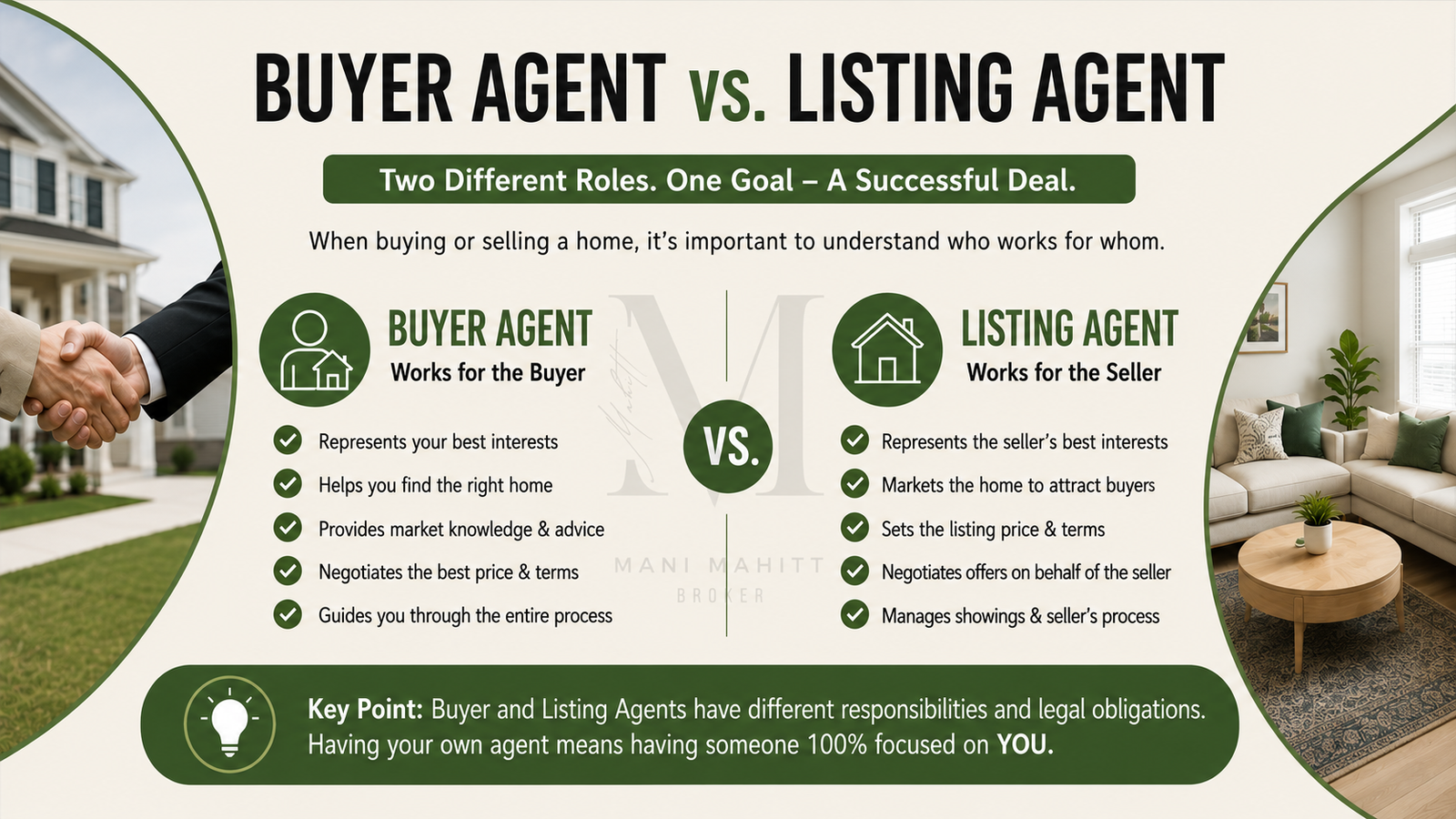
A buyer agent represents the interests of the buyer. Their role is to help a purchaser identify suitable properties, assess value, prepare an offer, negotiate terms, and coordinate the path from accepted offer to closing. A buyer agent should be focused on the buyer's priorities, including location, property condition, timing, and the terms that matter most to that household or investor.
A listing agent represents the seller. Their work begins with a pricing and marketing strategy, then continues through property preparation, buyer inquiries, offer management, negotiation, and closing coordination. Their responsibility is to help the seller secure the strongest available outcome based on the seller's goals, market conditions, and property.That distinction matters because the same sale involves competing interests. A buyer may want the best possible purchase price, favorable conditions, and flexibility around closing. A seller may want the highest achievable price, fewer conditions, and a closing date that supports their next move.
Both sides can reach a fair agreement, but each party benefits from understanding who is advocating for which priorities.
What a buyer agent does for a purchaser
A good buyer agent does more than arrange showings. They help turn a broad property search into a sound decision. In Brampton, Mississauga, Caledon, and across the GTA, that often means comparing properties beyond the listing photos and asking the questions that affect value over time. For a family, the right guidance may include school-area considerations, commuting patterns, future space needs, and the differences between nearby streets or housing types.
For an investor, the conversation may focus more closely on local demand, permitted uses, comparable sales, lease potential, or exit strategy. The advice should reflect the property and the client's actual plans, not a one-size-fits-all checklist.When it is time to offer, a buyer agent can review comparable sales, explain the competitive environment, discuss available offer terms, and negotiate on the buyer's behalf. They also help keep the process organized after acceptance by communicating with the parties involved and tracking key dates.
No agent can eliminate every risk, but responsive guidance can make a fast-moving decision feel far more manageable.
What a listing agent does for a seller
A listing agent begins by helping a seller make a strategic decision about price, timing, and presentation. Pricing is not just a number chosen from an online estimate or a neighbor's sale. It should reflect the home's condition, recent comparable transactions, current inventory, buyer demand, and the seller's preferred approach to the market. From there, the listing agent develops a marketing plan, manages showings, communicates feedback, and evaluates the quality of incoming offers.
The highest price is not always the strongest offer. Financing, inspection or other conditions, deposit, closing date, and the buyer's overall ability to complete the purchase can all influence a seller's decision. During negotiations, the listing agent advances the seller's position. That can mean seeking better price or terms, clarifying offer details, and helping the seller respond without unnecessary delay. For sellers who are also buying their next property, this timing and negotiation work can be especially important.
What a listing agent does for a seller
A listing agent begins by helping a seller make a strategic decision about price, timing, and presentation. Pricing is not just a number chosen from an online estimate or a neighbor's sale. It should reflect the home's condition, recent comparable transactions, current inventory, buyer demand, and the seller's preferred approach to the market. From there, the listing agent develops a marketing plan, manages showings, communicates feedback, and evaluates the quality of incoming offers.
The highest price is not always the strongest offer. Financing, inspection or other conditions, deposit, closing date, and the buyer's overall ability to complete the purchase can all influence a seller's decision. During negotiations, the listing agent advances the seller's position. That can mean seeking better price or terms, clarifying offer details, and helping the seller respond without unnecessary delay. For sellers who are also buying their next property, this timing and negotiation work can be especially important.

Representation is not the same as access
A common source of confusion is assuming that the agent hosting an open house or responding to an online inquiry automatically represents the buyer. That is not necessarily the case. A listing agent can provide factual information about the property and facilitate a viewing, but their representation relationship is with the seller unless another arrangement has been clearly established. Before discussing your offer strategy, price limit, or personal circumstances in detail, ask what type of relationship is being offered.
In Ontario, brokerages are required to explain representation and obtain the appropriate agreements and disclosures. Take time to read them. This is not paperwork to rush through because it defines the service, obligations, and communication you can expect. A buyer representation agreement may set out the area, property type, duration, and compensation arrangement for the relationship. A listing agreement similarly establishes the terms of the brokerage's work for the seller. The details can vary, so clear questions at the beginning are better than assumptions later.
Can one agent work with both buyer and seller?
Sometimes a buyer becomes interested in a property listed by the same brokerage or agent. In Ontario, this may involve multiple representation or another permitted representation arrangement, depending on the circumstances and brokerage structure. It requires informed consent and clear disclosure.This is not automatically wrong, but it changes the conversation.
When one representative or brokerage is involved on both sides, the ability to provide advice on negotiating against the other party may be limited. A buyer and seller should understand exactly what services will be provided, what information will remain confidential, and how negotiations will be handled before agreeing to proceed.For some clients, the convenience of working within one arrangement may be acceptable. For others, separate representation provides greater comfort and clarity, particularly when price, conditions, or timing are highly sensitive.
There is no universal answer. The right choice depends on the property, the proposed arrangement, and your confidence in the explanation you receive.Why local market knowledge changes the adviceThe buyer agent versus listing agent decision is not only about job titles. It is also about whether the professional understands the market segment you are entering.A townhome in a rapidly changing Brampton neighbourhood, a condominium in Mississauga, a rural-residential property in Caledon, and a commercial opportunity in the GTA each call for different local context. Comparable sales must be truly comparable. A closing date that works well in one situation may create pressure in another. Even buyer demand can vary significantly by neighbourhood, property type, price range, and time of year. For buyers, local knowledge supports a more disciplined offer strategy. It helps distinguish a property that is fairly priced from one that needs closer scrutiny.
For sellers, it supports a pricing and launch plan built around current competition rather than outdated expectations. Data matters, but so does the ability to interpret what the data means on a particular street and for a particular type of buyer.
Questions to ask before you choose representation
The best agent relationship begins with a direct conversation. You should feel comfortable asking how the agent will advise you, communicate with you, and manage the details that can affect your outcome.
Consider asking:
Who will you represent in this transaction, and what does that mean in practice?
How will you determine an appropriate offer price or listing price?
What experience do you have with this neighbourhood and property type?
How will you communicate during showings, negotiations, and the period before closing?
What happens if a multiple representation situation arises?
Listen for specific, plain-language answers. An agent who explains trade-offs clearly is usually more valuable than one who promises a simple outcome in a complex market. You should also understand how compensation is structured and documented before committing to an agreement.
Choose guidance that fits your moveIf you are buying, look for representation that protects your ability to evaluate properties carefully and negotiate with purpose.
If you are selling, choose an advisor who can provide a realistic pricing strategy, strong market exposure, and steady communication from launch through closing.
If you are doing both, planning the timing of each transaction deserves just as much attention as the properties themselves. Real estate decisions are personal milestones, not just contracts. A clear conversation with a trusted local professional can help you identify the representation arrangement that fits your goals, ask better questions before an offer is signed, and take the next step with less uncertainty.
At Mani Mahitt Real Estate, that starts with listening to the move you are trying to make and building a plan around it.